Staff Software Engineer at Gridfuse GmbH
– ← Back to cvTechnologies
Table of contents
Intro
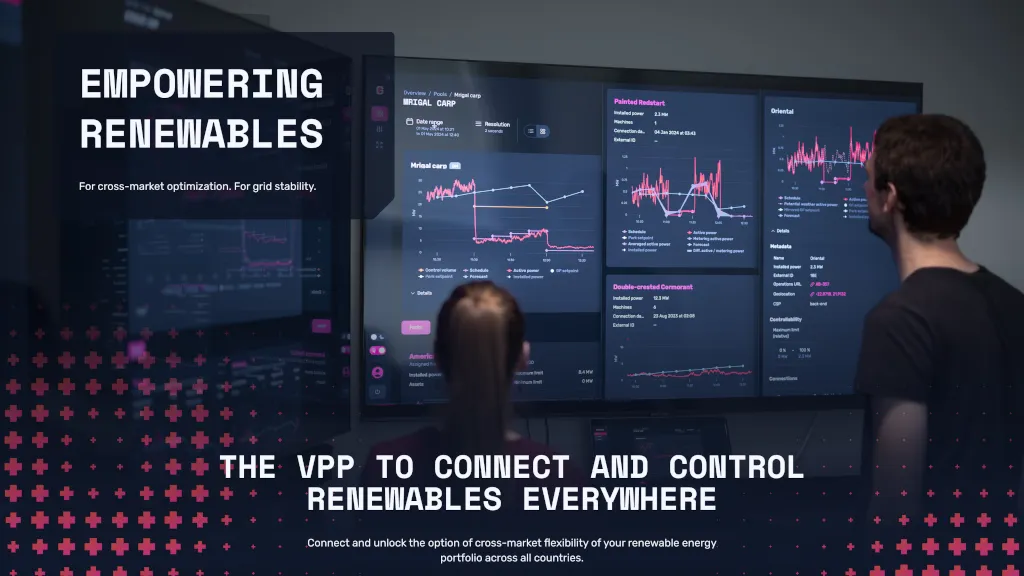
Gridfuse runs and develops a virtual power plant (VPP) for renewables.
Tangent on renewable VPPs
The idea is to treat multiple renewable power sources as one virtual whole.
This allows optimizing in different dimensions like profit and contribution to the energy grid.
By treating multiple power sources as one the uncertainty in these power sources can be reduced. This also opens up new markets for renewables such as ancillary services.
TL;DR
At Gridfuse the focus of my work widened.
While I still spent a portion of my time with the frontend team, my contributions across teams now became the norm and were regularly where I spent the most effort.
I was in continuous exchange with stakeholders across all teams, both to push work I noted as pressing to the right people and to take care of overarching aspects.
I spent extended time and care with the following aspects:
- Frontend team
I’ve been working as a key developer and technical lead in the frontend team. This included mentoring and moderation just as well as fostering the technical advancement and architecture of software components.
- Exploratory work
I spent dedicated time on exploratory work for pressing or unclear problems to come up with reliable solutions and prototypes. This happened both prompted by management and other stakeholders as well as motivated by my own concerns.
- Development processes
I routinely supported different constellations of developers in work organization and introduced new formats and artifacts as the needs arose.
- Communication and mentoring
To have impact at larger scale I cultivated a pattern of continuous exchange with peers and stakeholders. I believe in empowering others and sharing ideas over pushing ideas onto people without learning the details that worry them. Gardening over architecture.
- Distributed systems
Consulting on and evaluation of distributed systems architecture and concerns. This led to the correction of several early implementations and raised the bar across the company.
- Security
I contributed to the security of Gridfuse software and services, both in finding and addressing open issues as well as in shaping architecture and solutions. I believe I’ve made a clear positive impact here and see that reflected in how my peers and management would frequently consult me on the topic.
Becoming a staff engineer
I was originally hired as a senior frontend developer. At end of my probationary period it was already recognized that my contributions clearly exceeded expectations and so I was promoted to the newly created role of staff software engineer after my first yearly feedback.
Frontend team
At Gridfuse I started out with frontend development, and I remained with the team for the entirety of this job. I believe frontend work forms a good vantage point to get involved with a system in breath and detail.
Tangent on frontend as a vantage point
I believe frontend work makes for an excellent vantage point to understand a system and be involved with many parts.
Frontend work requires constant exchange with various stakeholders and easily means that you’re building software interfacing with most internal APIs.
For debugging and reliability reasons alone you already have a strong interest in backend details and deployments.
In my eyes this makes frontend a good vantage point, because you are in constant exchange with most moving parts anyway and you’re frequently at the top of dependency chains, relying on all other parts of a system.
I see two key aspects in my work with the frontend team at Gridfuse:
Mentoring and support
My top priority was supporting other team members, enabling and mentoring them where possible.
Our team worked at a high degree of independence and for this alignment of practices and knowledge transfer were central enablers.
I formed development practices and a praxis of workshops and documentation in the team. My work here left its clear mark on architecture aspects and code style.
Our team developed a shared pride in our craft and its independence was central to my ability to spend time on cross team work and larger system development in the company.
Special problems
Every now and then less usual problems turned up in frontend, and I had the pleasure of addressing these with independent times of focus.
Examples of this include:
- Demo mode
By creating a simulated data layer we could demo the product to third parties without exposing sensitive production details. We verified API coverage and compatibility using the typesystem.
- Date inputs
UI components for date inputs that support native input methods as well as relative date/time designations.
- Frontend performance
Noted critical performance concerns months ahead, briefed management, implemented countermeasures and coached developers.
- Data-driven analytics
Oriented architecture decisions and software evaluation on metrics and measurements. I like good intuition, but prefer facts.
Tangent on less special problems
This is by no means to say that I would be above participating in the basics of work.
I believe the opposite is and should be true:
I will gladly do the basic work if that is what needs doing and is also the best use of my time.
However: If I can lift up the rest of my team by solving a hard problem, keeping them in the loop as I progress and then onboard them to something good, I will not wait to do so.
I will do my best to lift up my peers. I will not ask permission or apologize for leveraging my skills to the benefit of my peers.
Exploratory work
At various times working at Gridfuse I worked on problems without a clear solution that required some exploration.
Sometimes I found these problems myself and other times stakeholders raised them to me. I took pride in being the goto person for such issues and enjoyed coming up with novel approaches and developing them into prototypes.
Where possible I cooperated with peers and made sure to get buy-in for my prototypes and to align them with existing software constraints.
Tangent on quality
When working on prototypical solutions and exploring new problems
I made sure to keep an extra eye on quality and attention to detail.
I believe that especially for things that impact the course of a company it is my duty to make sure as good as I can that things work out.
At the end of the day someone has to do the math, and check the merit and quality of a solution.
I’ve found that it may not always be easy for non-engineers to understand the risk that is minimized. I’ve seen weeks and months of work go to waste because of poor work in this step, and I take pride in knowing the details even in face of pressure from management.
I believe that slow is steady and steady is fast, and I’m less interested in firefighting as a routine activity.
Examples of my work in this area include:
- Single park accuracy
Given a wind farm, measurements and forecasts: what are the strategies to control it to most accurately produce the desired power output?
Prequalification for ancillary services
Which conditions maximize the chance to prequalify parks for ancillary services? What are the chances to qualify a park under some conditions?
- Park mechanical stress
Estimate and compare conditions that cause mechanical stress for wind turbines to supplement business decisions
- Failure detection
Explore and illustrate how employment of the φ accrual failure detector can lead to reusable, multi-purpose health metrics across the VPP, coaching management, operations and engineers alike.
Development processes
In my time at Gridfuse I continuously shaped development processes.
This includes routine tasks like moderating discussions, preparing meetings and documenting results just as well as discovering the need for some specific processes and introducing them across the company.
Some examples of my work in this area are:
- Frontend manifest
As the company grew I noticed diverging expectations and practiced among developers. To address this I established a shared manifest in the frontend team. In my eyes this aided team alignment, reduced discussion overhead and fostered self-governance.
- Cross-team task-forces
For bigger work items such as migrations of central databases involving multiple teams I was empowered to establish a task force of engineers in collaboration with their management. This allowed the construction and orchestration of complex migration plans spanning executed over several months.
- Incident reports
I introduced the praxis of writing incident reports as system parts moved into production. This aided communication with stakeholders, developer ownership and the common error culture.
- Patchdays
Repeated demonstration of security issues and lacking patch levels allowed me to push for a praxis of dedicated patch days. This led to a higher degree of automation and testing as well as a clearer understanding of patch levels and recency of security checks.
- Threat modelling
I illustrated threat modelling approaches in talks and paired on the subject with engineers from several teams. I created the initial threat model for Gridfuse frontend services.
Communication and mentoring
A central building block of my impact as staff engineer was communication and mentoring.
I needed to make sure different parties were in the know and on board with plans and new developments and I absolutely needed to stay on top of new developments to contribute and spot complications.
Similarly enabling others and lifting them up allowed me to spread load and involve others in solutions.
Examples of my work under this aspect are:
- Engineering Managers
I would brief Engineering Managers in regular meetings to discuss upcoming systemic issues that required cross-team collaboration. These meetings would frequently inform my work for the next week to tackle hard problems for individual teams.
- Talks
I curated an internal bi-weekly talk format to practice presentation skills and foster a culture of knowledge transfer. Talks were held on a wide variety of topics, often but not exclusively programming related. The format was well loved with people actively looking forward to the shared learning experience.
- Articles
I frequently wrote opinion pieces on a wide set of engineering issues. I believe that success of more complex engineering tasks hinges on sharing and aligning on ideas. Writing them down was a frequent helpful addition to individual talks and presentations.
- Dedicated sessions
On a situational basis I frequently pursued sessions with individuals or small groups. This was both to solve current problems in form of pair programming and coaching as well as developing shared ideas and exchanging on upcoming development challenges.
- Developer experience
At various times I spotted improvements to the developer experience at Gridfuse and pushed them forward effectively. Examples are automated checking for breaking API changes across all services and API tooling that integrates well with authentication and tracing.
Distributed systems
The requirements of a virtual power plant imply the creation of a distributed system.
I took pride in thinking through several aspects of distributed systems and in guiding the architecture towards reliable solutions.
Frequent aspects included
- System reliability and scalability
- Consulting on consistency constraints
- Setup evaluation
- Distributed tracing
I was frequently consulted on these topics by engineering management and other developers and helped steering towards reliable, flexible solutions that fit the constraints at play.
Security
I have a long standing passion and interest for security aspects.
Falling under KRITIS (critical infrastructure) and ISO 27001 regulations VPPs have a higher need to take care of security aspects than some of my previous engagements. Critical infrastructure means that some risks cannot be accepted and need to be addressed accordingly.
It was my joy to contribute to this system aspect in multiple ways.
Examples of my work on security aspects are:
- Web technologies
I took care of these security aspects:
- security.txt
- HTTP hardening
- Threat modelling
- Supplychain security
I was one of two engineers tasked with creating the initial concept for an IDS at Gridfuse. Tasks included creating a service inventory, threat analysis, classification of attacker personas as well as consulting and recommendations.
- Authentication
I devised patterns for in-depth authentication with robust alignment across services. I coordinated implementation across several teams, spreading and documenting knowledge. I audited critical authentication code and aided the company in raising implementation quality from prototype to production level.
- CVE triage and handling
- Checking critical components
- Verifying/reproducing issues
- Delegation to specific teams
Hey 🤗 you’ve made it to the end.
As a treat enjoy this animation of the Gridfuse logo and plusses I made with Blender for funsies: